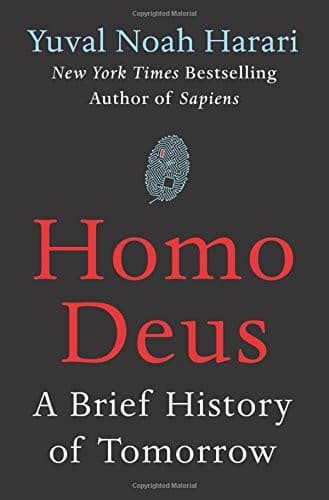
Homo Deus
by Yuval Noah Harari
- Non-fiction
- Futurism
- Philosophy
Once algorithms decide better than feelings, the real question is who designs the data flow.
- Author
- Yuval Noah Harari
- Type
- Non-fiction
- Genre
- Futurism, Philosophy
- Published
- 2016
The follow-up to Sapiens, and the one closest to the systems engineers are building now.
What it's about
If Sapiens is about where we came from, Homo Deus asks where we are going. Harari argues that with famine, plague, and war increasingly under control, humanity's next goals may be longevity, happiness, and god-like powers of creation. He then examines humanism, the belief that human feelings and choices are the ultimate source of meaning, and asks what happens to it when algorithms understand us better than we understand ourselves.
What stuck
Humanism as an operating system. Much of modern life, from elections to markets to "the customer is always right", assumes that individual feelings are the final authority. Harari treats this as one worldview among many, and a fragile one.
Intelligence is separating from consciousness. Systems can now do intelligent work without experiencing anything. That separation is the core of his argument, and it frames a lot of today's AI debates more clearly than most technical writing does.
Dataism. Harari describes an emerging belief that the universe consists of data flows and that value comes from contributing to them. Whether or not you buy it, it is a sharp description of how many platforms already reason about users.
Useful questions, not predictions. He is explicit that these are possibilities to think about, not forecasts. I found that framing honest and more useful than confident prophecy.
What I'd apply
- When a system makes decisions for people, be explicit about whose judgement it is replacing and who can override it.
- Design for the human in the loop deliberately, not as a leftover step. The more capable the automation, the more that design matters.